 photoartflight
Dragons & Damsels Panoramas
Posted on June 19, 2020

Panoramas are not just for landscapes! I enjoy shooting panoramas for a variety of subjects. Plus they look interesting when you print them very large! Here are a series of multi-image Dragonfly & Damselfly Panoramas. I was using Canon & Panasonic Cameras, with a variety of lenses. The featured Blue Dasher Dragonfly image was 5 handheld images taken with a Canon 300mm lens, with extension tubes @ f/9, 1/250th sec. Then assembled and blended in Photoshop. When shooting panoramas handheld, I tend to overlap even more just to be safe & that I got enough overlap to blend nicely. I may not need them, but it helps if you do need more images when assembling them. The images below have some details on exposure & images shot per panorama.
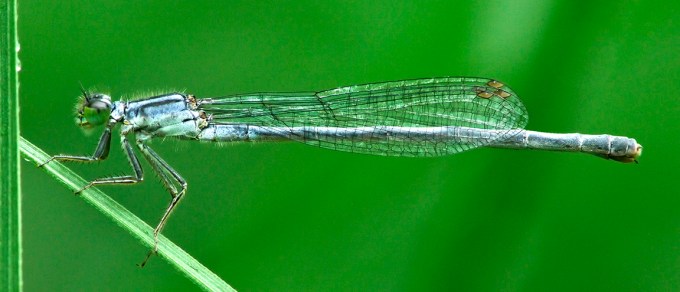
Eastern Forktail Damselfly, 4 image panorama, Panasonic GH2 with adapted Canon FD 200mm Manual Focus Macro lens, blended in Photoshop.
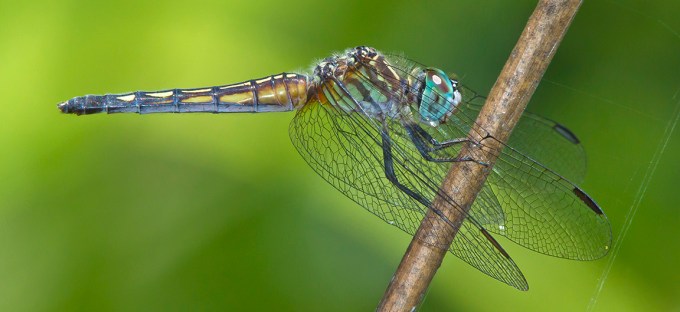
Blue Dasher, Female – 400mm DO lens with extension tubes, Canon 1D mkIV, 3 image panorama, f/11, 1/250
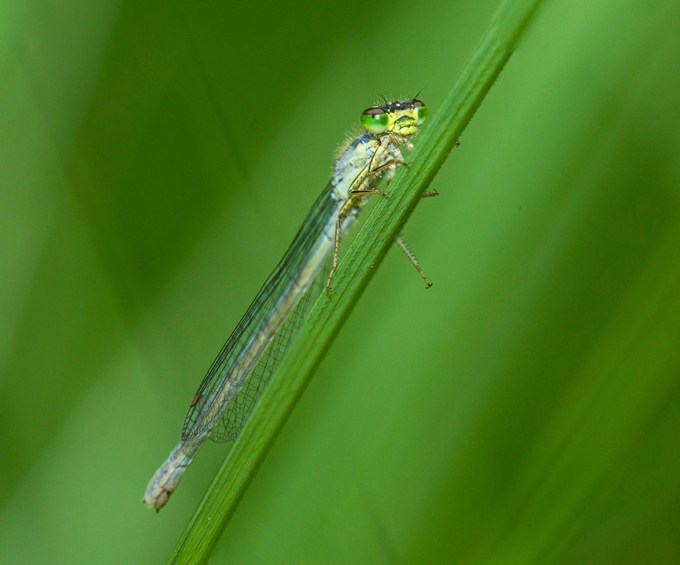
Eastern Forktail Damselfly, 3 image panorama, Panasonic GH2 with adapted Canon FD 200mm Manual Focus Macro lens
Blue Dasher Dragonfly With Water Mites
Posted on May 30, 2020

I was surprised to see so many water mites on this Blue Dasher Dragonfly! Usually you only see a few mites, but this one was really loaded with them! The water mites get onto late stage nymphs, then emerge with the nymph. As the dragonfly emerges from the nymph stage, the mites transfer to the adult dragonfly.
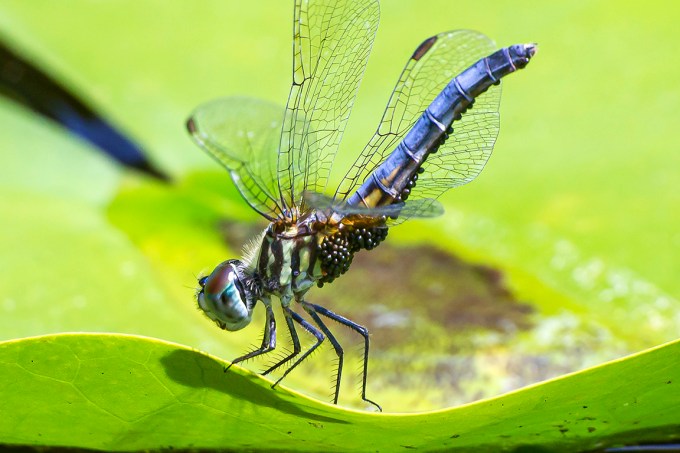
Closer view to show water mites
Extreme Methods To Photograph Distant Dragonflies
Posted on May 28, 2020

This is a series of some Blue Dasher & other Dragonfly images I shot over a few years using a technique for getting softer smoother backgrounds for dragonflies that you can not get close to photograph. Depth of field is limited with this technique, but I like the softer backgrounds which makes the detail in the dragonfly stand out. The subject Dragonflies are about about 5 to 9 feet away. Usually they are on a plant or branch in or over the water. Plus I get closer up images not needing a large or any cropping. I was using a Canon 400mm DO lens with a 1.4x teleconverter(s) and extension tubes to get closer focus on the small (about 1.5 inches long) Dragonflies. Basically converting the lens to only closer focusing capability. Sometimes I would setup the equipment with the lens, then extension tubes, the teleconverter and then camera. Or have the lens, teleconverter, extension tubes, then camera body. Different arrangements of extension tube(s) & teleconverters gives different “focus zones”. Depending on the width & position of the extension tubes used is how close you can focus on your subject. With all the added converter(s) & extension tubes you may loose autoexposure so I mainly set exposure by looking at a preview shot or histogram and adjust exposure from there. It takes a while to get consistent results because there are so many variables. But it works well once you get used to it. Many times I use fill flash to help light the subject because I loose so much light with certain combinations of teleconverter(s) and extension tubes.
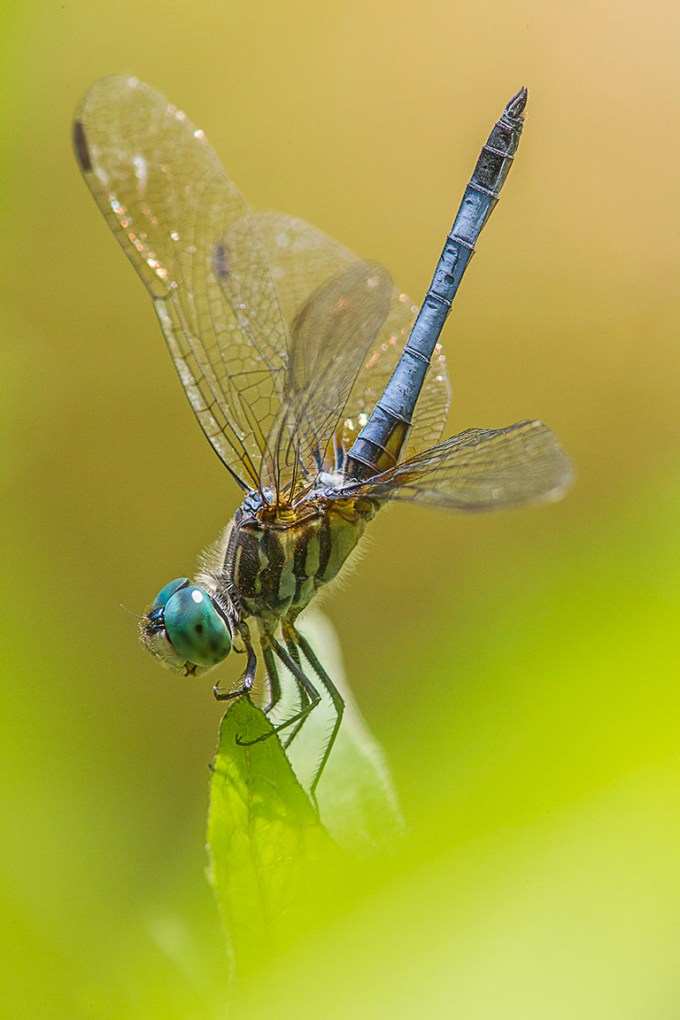
Image somewhat soft on the bottom of the image from shooting through plants that were in the way, but liked the image anyway!
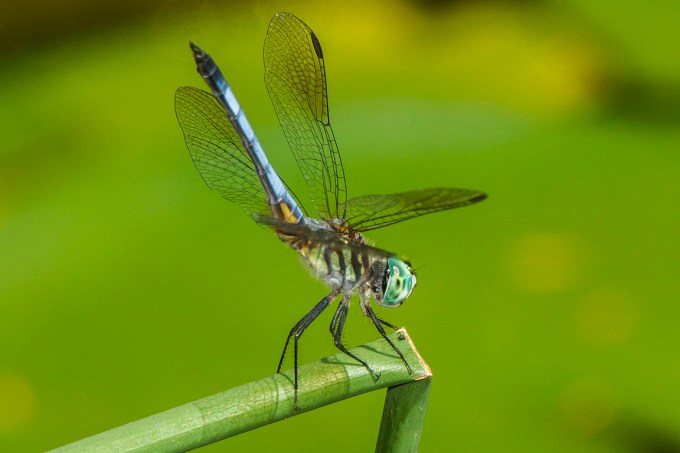
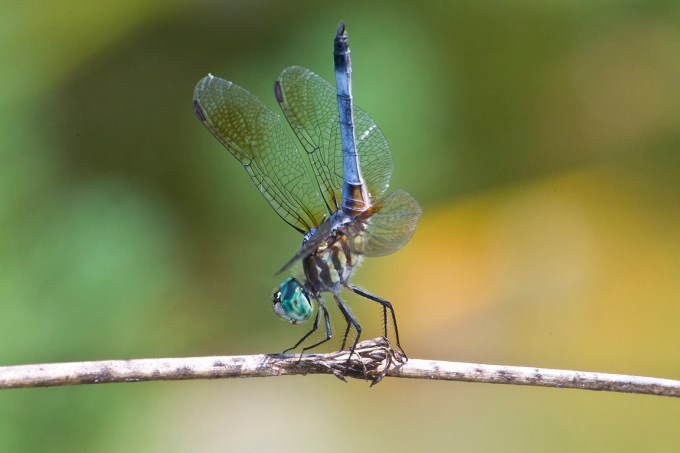

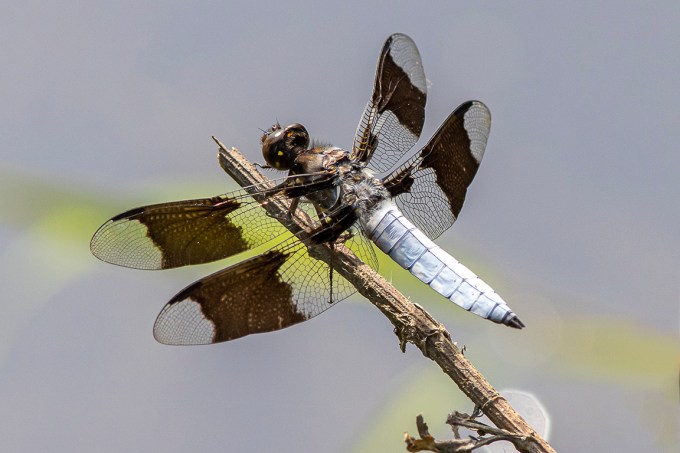
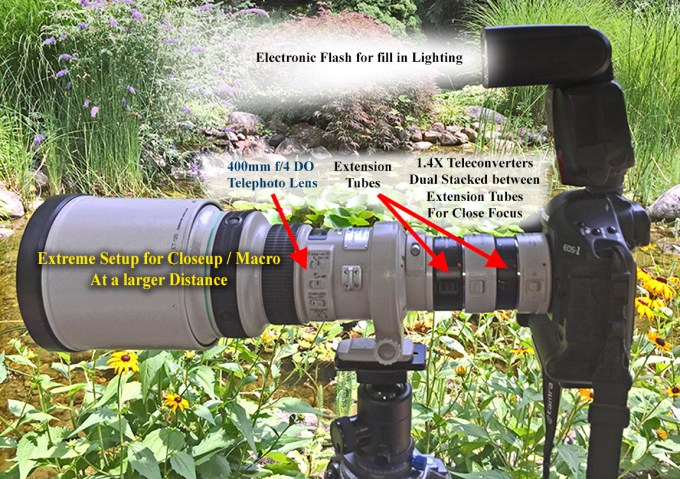
Showing an even more extreme “closeup” setup with double extension tubes & double 1.4x teleconverters (staggered). Also Fill flash to open shadows – usually with a BetterBeamer flash extender.
Recent Dragonfly Images
Posted on September 1, 2019
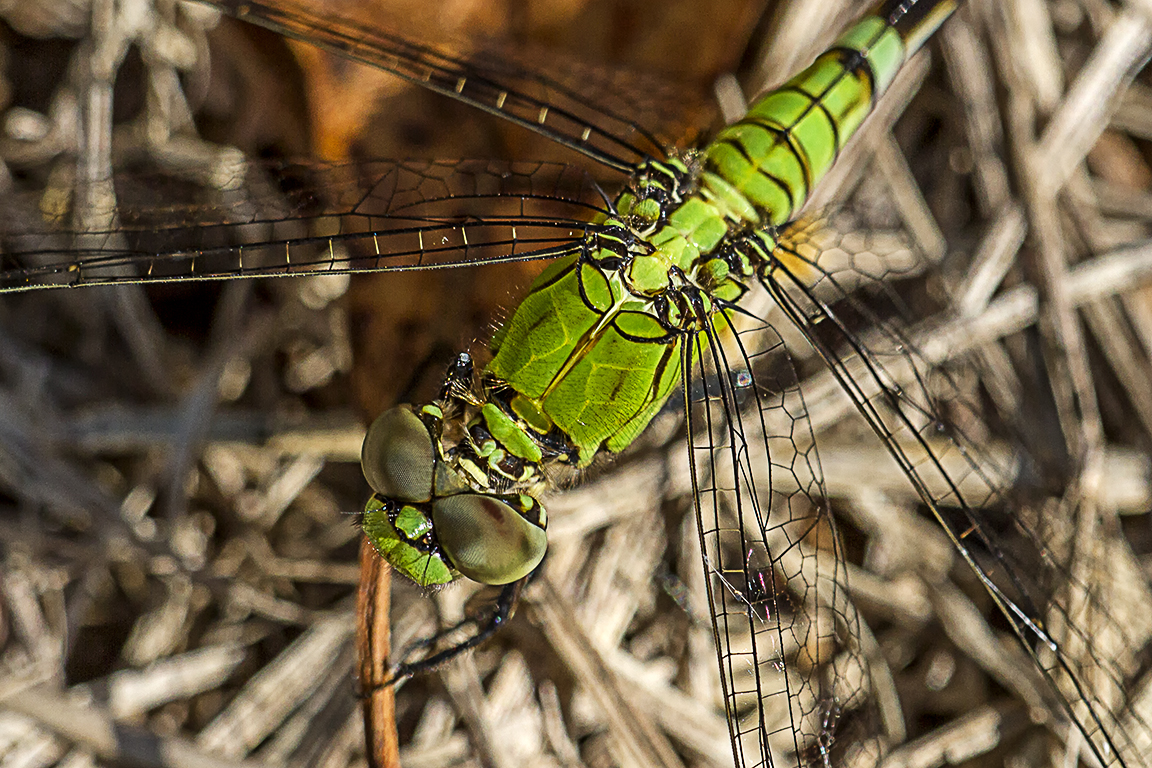
Here are a few images of Dragonflies and a Damselfly from a few local parks in our area. Most were shot with a close focusing 300mm f/4 lens with either extension tubes to get closer or 1.4X or 2X teleconverter. A few I used a Canon 400mm f/4 DO with Extension tubes and 1.4X teleconverter. The featured image is a female Eastern Pondhawk that was quite cooperative for extreme closeups. Image taken with Canon 7D, handheld, 300mm @ f/8, 1/1000 sec, ISO 400.

Blue Dasher extreme closeup – 2 image focus stack Canon 7D, Canon 300mm f/4 IS, 1.4X teleconverter, w/extension tubes
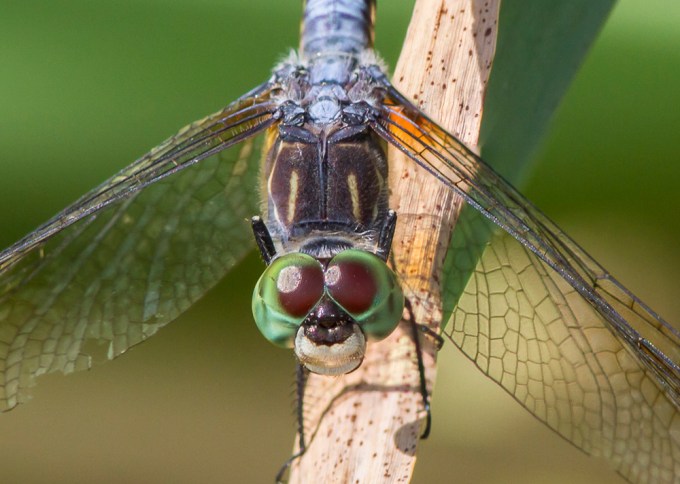
Blue Dasher extreme closeup – 2 image focus stack Canon 7D, Canon 300mm f/4 IS, 1.4X teleconverter, w/extension tubes (f/11, 1/200 sec, ISO 400)

Damselfly – multi image stack, 400mm f/4 DO with extension tubes, f/8, 1/50 sec, 1600 ISO, camera on tripod
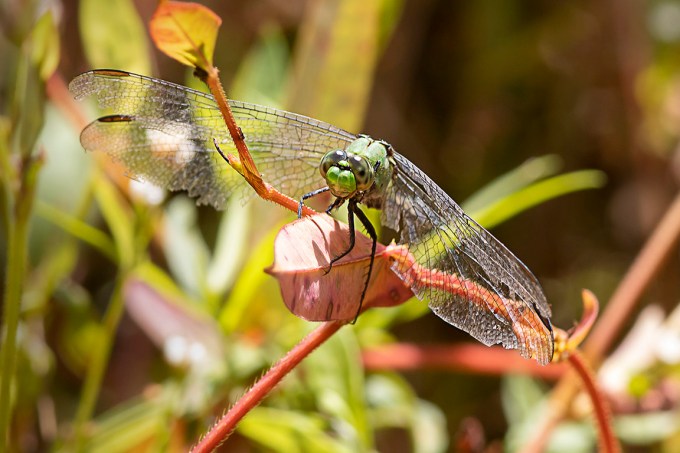
Female Eastern Pondhawk- f/11, 1/320 sec, 300mm f/4 w/ 1.4X teleconverter
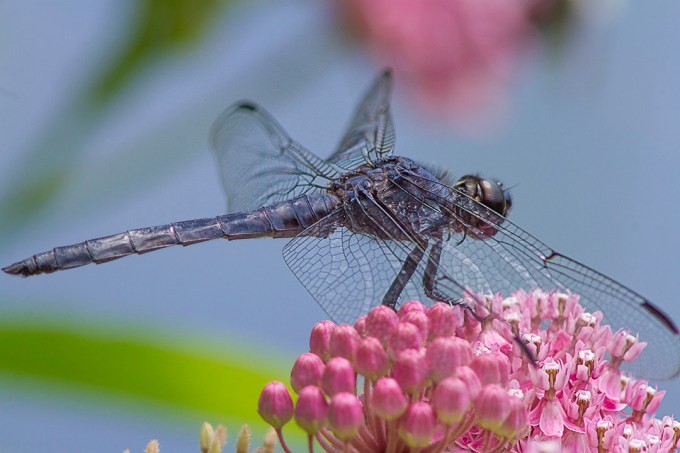
Slaty Blue Dragonfly, f/11, 1/160 sec, +1/3 exp. comp, 300mm w/ 2X teleconverter, Single image, flew off before focus stacking images
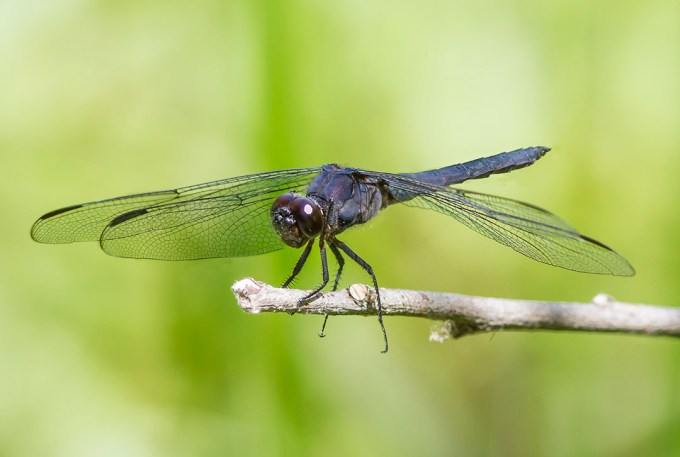
Slaty Blue Dragonfly, f/10, 1/320 sec, 300mm w/1.4X teleconverter, effective 420mm
Male & Female Blue Dasher Dragonflies
Posted on August 22, 2019

We went to a local park to see what we could find. Found a few Blue Dashers by the ponds, but most were looking the worse for wear. Then I concentrated on Butterflies that were around. When photographing Dragonflies I usually shoot multiple images at different focus points. This is to keep a smoother background and still get more of the dragonflies body and wings in somewhat sharper focus. It also depends on if the dragonfly cooperates and does not change position or flies off. The featured image I only had time for 1 shot so the tail is softer. The others were 2 images, so somewhat more depth of field.

Female Blue Dasher Dragonfly – f/8, 1/80 sec., +0.33 Exposure Compensation

Male Blue Dasher Dragonfly – 2 image handheld stack to retain more image sharpness from head to tail and still keep a smoother background. Canon 300mm f/4 Close Focusing lens, with 1.4X Teleconverter shot @ f/11 – 1600 ISO
Dragonflies From Davidson’s Mill Pond Park
Posted on June 30, 2019

We went to a local park to look for Dragonflies or other investing subjects to photograph. It seems like it is a slow start for dragonflies at this local park compared to other years. But we did manage to photograph a few different types. It was still fun to see what we could find.

Blue Dasher – male

Eastern Pondhawk – Female

Eastern Pondhawk- Male
Common Whitetail- Male

Slaty Skimmer – Male
It Is Dragonfly Season
Posted on June 14, 2019
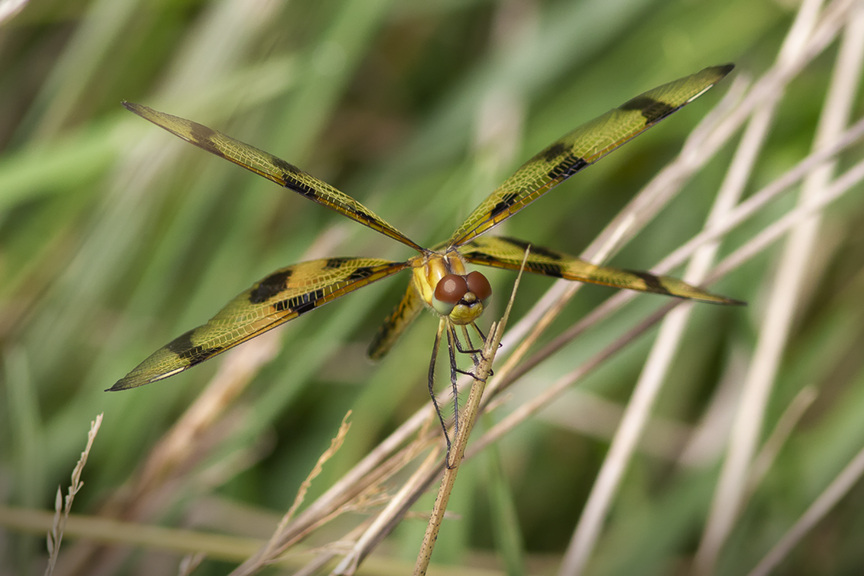
Some of my favorite photo subjects are Dragonflies and Damselflies. Here are a few Dragonflies to start with. The featured image is a photo of a female Calico Pennant. I was using a 300mm lens that has a close focusing capability, with a 1.4X Teleconverter for a combined focal length of 420mm.

Blue Dasher Dragonfly – Female
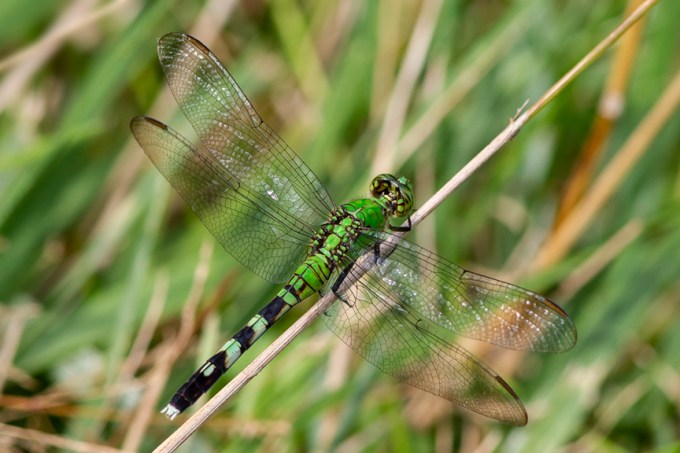
Eastern Pondhawk Dragonfly – Female
Blue Dasher Dragonflies Showing Signs Of Wear
Posted on July 17, 2018
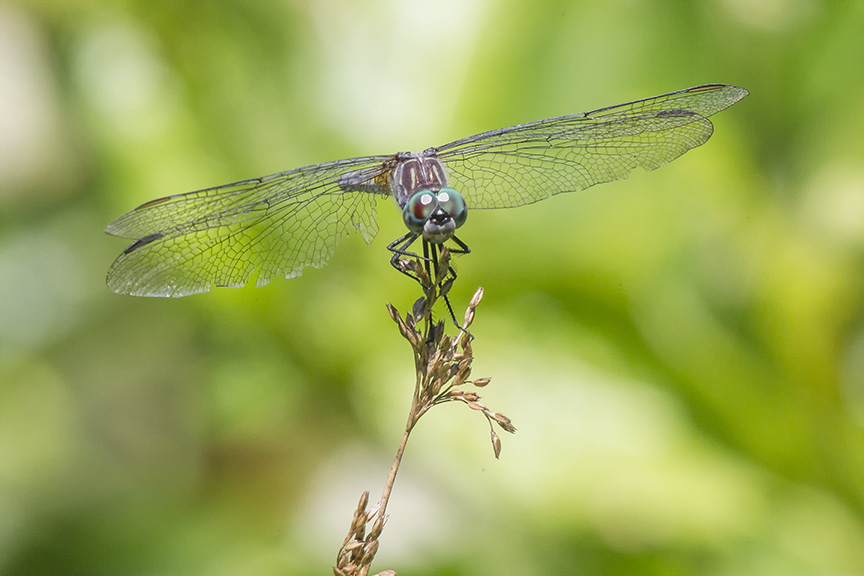
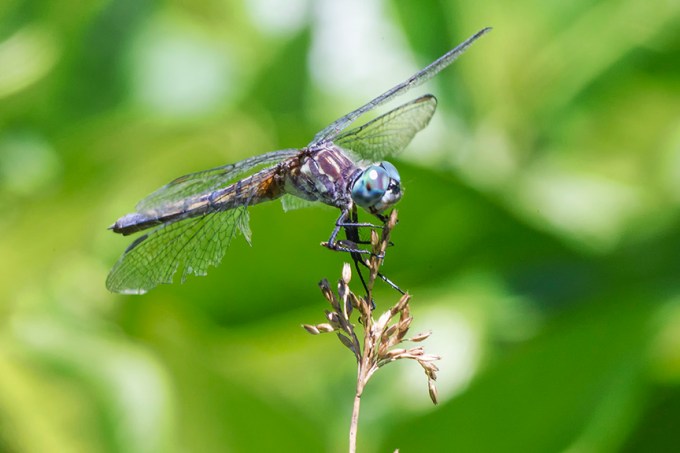
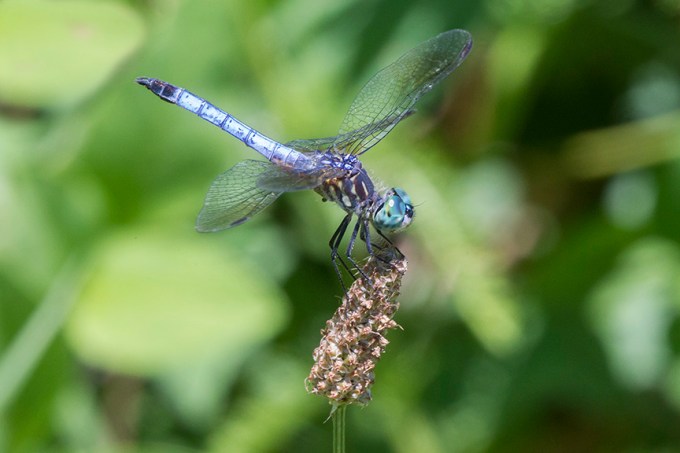
These Blue Dasher Dragonflies (males & females) are showing signs of wear already this season. Their wings have tears and missing areas.

Smiling Blue Dasher Dragonfly
Posted on July 6, 2018

For some reason Blue Dasher Dragonflies seem to look like they are smiling when you see them head on, giving an impression of a Happy Dragonfly. This Blue Dasher was out in a pond at a public county park, probably 6 to 8 feet from the shoreline. The featured image is a 4 shot Image Stack, manually focused and assembled in Photoshop. I used a combination of a 400mm lens, an extension tube, then a 1.4x teleconverter to actually enlarge the image on the sensor with the extension tube added. Sometimes I add another extension tube between the teleconverter and the camera body which enlargens the image on the sensor even more. But narrows your focus range even more and you tend to need a fill flash because of loss of light reaching the sensor to get a usable exposure for a subject that is somewhat moving its head or wings or its perch is moving in a breeze. Plus the added extension tubes also takes away light reaching the sensor. Sort of like the “Old” days when you were using a 4×5 or 8×10 view camera when you had the bellows racked out and had to adjust your exposure because of light loss from the distance of the lens and the film plane. By moving teleconverter and extension tubes you can get a variety of focus windows and enlargement of your final image on the sensor.
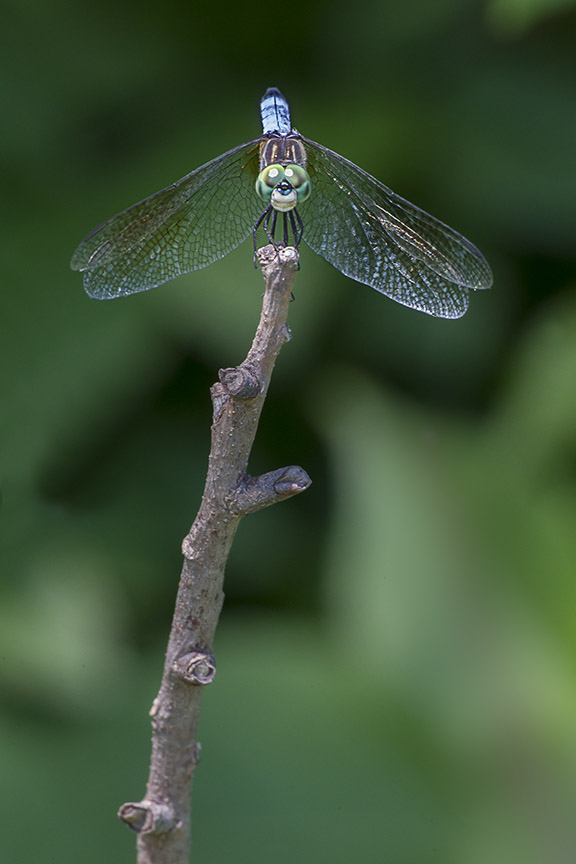
Blue Dasher 4 img Stack for Blue Dasher, then 4 image pano for the stick the Dasher was on. So 2 techniques used for final image.

Older shot showing similar Setup with one 1.4x teleconverter plus fill flash needed for using two separated extension tubes.
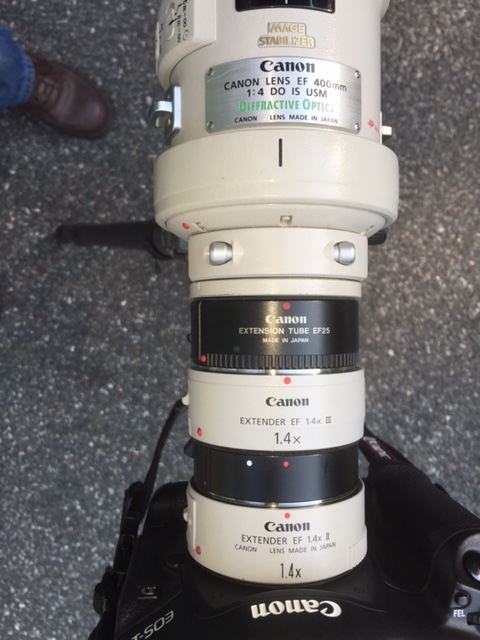
Another extreme setup with 2 extension tubes and 2 teleconverters. This really enlargens the image on the sensor but you need a fill flash or a very high ISO setting and has a very limited focus window.
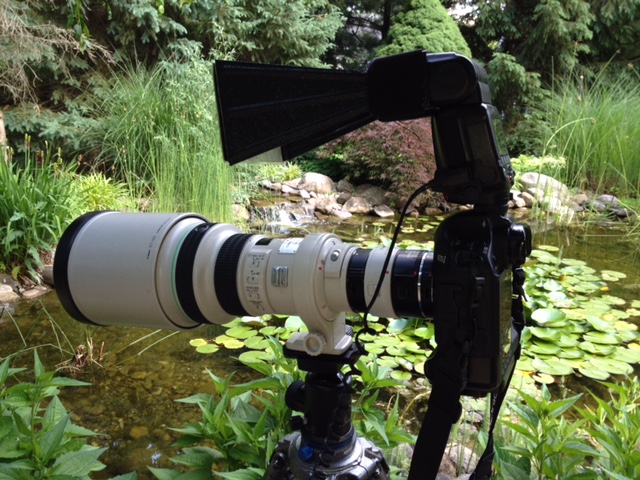
Dragonfly setup at my old pond
Blue Dasher Female Portrait
Posted on July 17, 2017

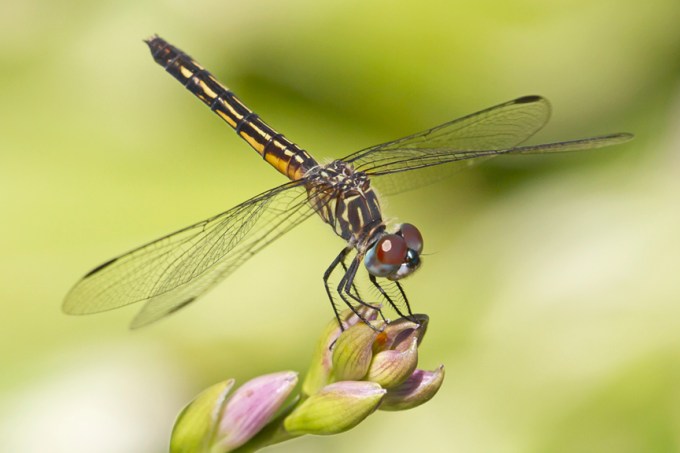
I found this female Blue Dasher in the yard. It was bouncing back and forth on the flowers. I stood watching for a few minutes and then it seemed to not fly off when I got closer. I guess it got used to me being there. I was using a 150mm macro lens with a 1.4x teleconverter so it allowed me to get pretty close. It is interesting that the female dragonflies are usually a different color scheme than the males. Sometimes makes it harder to ID.


 photoartflight