 photoartflight
Slaty Skimmer Dragonfly
Posted on June 25, 2018

We went to Davidson’s Mill Pond Park to look for Dragonflies and whatever else we could find to photograph. We found a lot flying around both the large pond and the small pond. There was a large variety but many of the larger dragonflies are constantly zooming by, so they are hard to get photos of. But we did find about 6 different types that were more cooperative for our photo interests. Along with quite a few damselflies. It is a hard location to get closeups because the ponds are lower than the surrounding grass areas with lots of vegetation and plants blocking the smaller plants on the shoreline where most of the Dragonflies were active. I was using a 300mm f/4 IS lens with a 1.4x teleconverter on a Canon 1.6x crop body. The 300mm lens can focus very close without using an extension tube. So the whole combination gave me a field of view equivalent to a 672mm lens which helped fill the frame with my distant subject Dragonflies. This is a 3 Image focus stack assembled in Photoshop for more sharpness from the head to wings & wingtips and to the tip of the tail.
Common Whitetail Dragonfly
Posted on June 4, 2018

We went for a walk at a local park looking for Dragonflies. We saw quite a few but not many close enough to get good photos of them. This year, so far, they seem wary and stay at a distance. This Common Whitetail landed close by on a piece of wood on our way out. Shot with a 300mm lens setup for close focusing for Dragonflies.
Young White Ibis Feeding Early In The Morning
Posted on February 17, 2018

I am still going through some of my images from our trip to Florida in the Fall. On our visits to the J.N. Ding Darling NWR, we tried to get there early. While I was walking the Indigo Trail early in the morning, hoping to find some birds trying to find breakfast. I came upon a group of White Ibises. The older birds were in the lower branches, working their way through the trees. There was this one younger adult, still showing some dark mottling on the face and neck, foraging on the ground. Again it was very dark, but it helped a little for my exposure that it was a white bird! I still had to use a minus exposure compensation, but I had to go even a little further than usual because I was using average metering, so I got a little higher shutter speed. Which I needed for my 300mm lens with a 1.4x teleconverter.

White Ibis with Breakfast Bug breakfast – Canon 300mm f/4 IS Lens, Canon Series III 1.4x teleconverter
–
Reddish-Egret – 2 Shot Pano
Posted on February 10, 2018
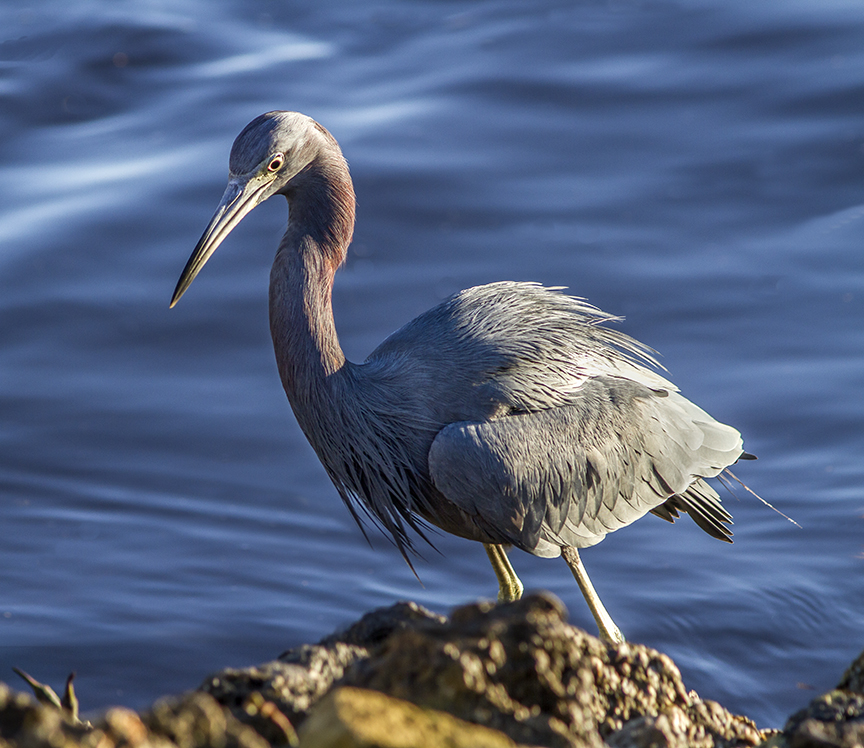
It is not often that while I am walking looking for photo subjects, that one comes so close I cannot fit it all in the viewfinder. So I try shooting my subject with 2 overlapping images. You have to take a few multiple images quickly, to try to avoid any movement of your subject. Usually a little movement, I can deal with. In Photoshop I try letting Photoshop automatically align and combine them. If that does not work I do it manually. So one way or another, it is a way to get the image.
The featured image is 2 horizontal images stacked vertically and combined.
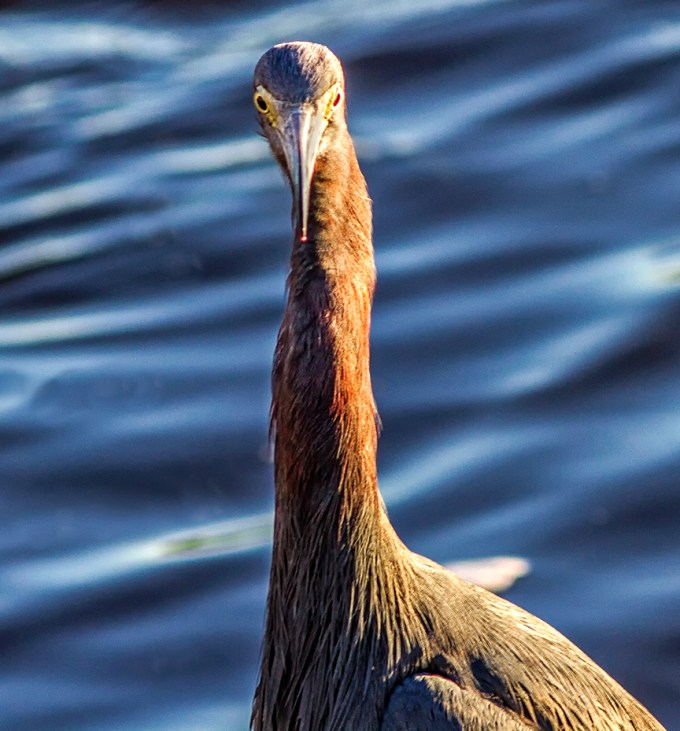
Another 2 shot composite. 2 horizontal images stacked in Photoshop. 300mm f/4 lens

Example – showing top half of image before combining and adjusting colors, etc. in Photoshop.
Yellow-Crowned Night-Heron Hanging Out In The Shade
Posted on February 6, 2018
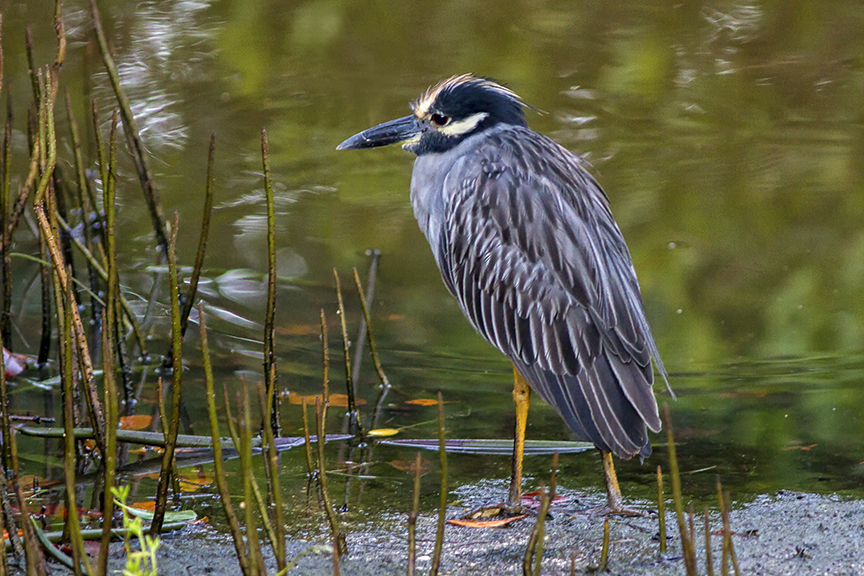
I was walking down one of the paths early in the morning at the J.N. Ding Darling NWR. It was pretty dark on the sides of the path under the trees and mangroves. I heard Ibises moving in the lower branches of trees and in the mangroves but were mostly hidden by branches. Plus it was extremely dark to get a photo. Then I noticed this Yellow-crowned Night-Heron out in the open, standing under the branches. It was still very dark because the branches were blocking the rising sunlight. The Heron did not seem to be bothered and did not move, so I took a few shots and moved on. It was so dark where the Heron was, my shutter speed was very very slow, so I shot a series of bursts and purposely underexposed to get my shutter speed up. I did not want to raise my ISO, because the Canon camera I was using gets more “noise” at higher ISO’s. It was easier to work on sharpness later. I was using a 300mm f/4 lens with a 1.4x teleconverter giving me f/5.6 wide open. I have more success with having less noise from not using a high ISO, and under exposing a little and then brightening my image in Photoshop. Then adding a “high” pass sharpening technique in Photoshop and blending it in.
Kayaker Rowing By- 2 Shot Panorama
Posted on January 19, 2018
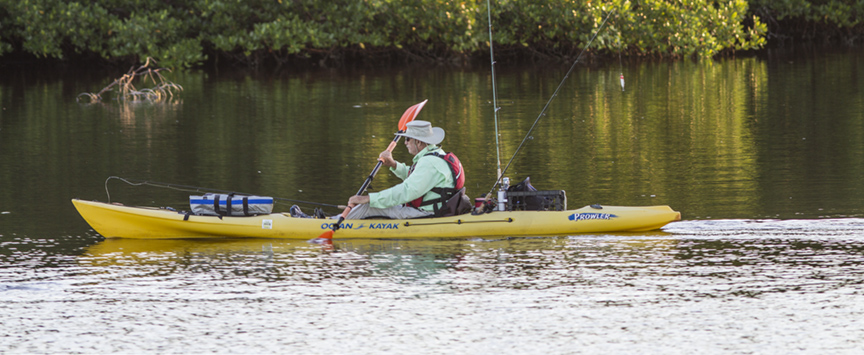
Sometimes you just shoot what happens to go by you. I was waiting early in the morning, for some birds to fly in, when this fisherman in a kayak rowed by. So I shot a quick two shot panorama, handheld, as it went by. Sometimes just to see if it works or to get practice for multi-image moving panos. I was using a 300mm f/4 lens with a 1.4x teleconverter. On a moving pano, I try to get the area with the most movement in one non-blended section and the section with less movement in the “overlapping” section. Sometimes it works, sometimes it does not. But it is fun to give it a try!
Early Morning With American White Ibises Foraging In Trees
Posted on January 13, 2018

Getting to the J.N. Ding Darling National Wildlife Refuge early in the morning I was looking for photo subjects. When I was there it was not the best time of year for an abundance of photo subjects, but it was still fun to see what I could find. And it was nice to be in the Florida sunshine. You could hear rustling of leaves and knew a few birds were foraging in the lower branches of the trees. So I was waiting for them to come to me so not to scare them off. With all the branches it was hard to get clear shots of them, but it shows how they forage. This group had about a dozen Ibises, but most were hidden by the branches. Not great images but it was fun to watch them.

 photoartflight