 photoartflight
Sandpiper Walking Along The Beach
Posted on July 3, 2017
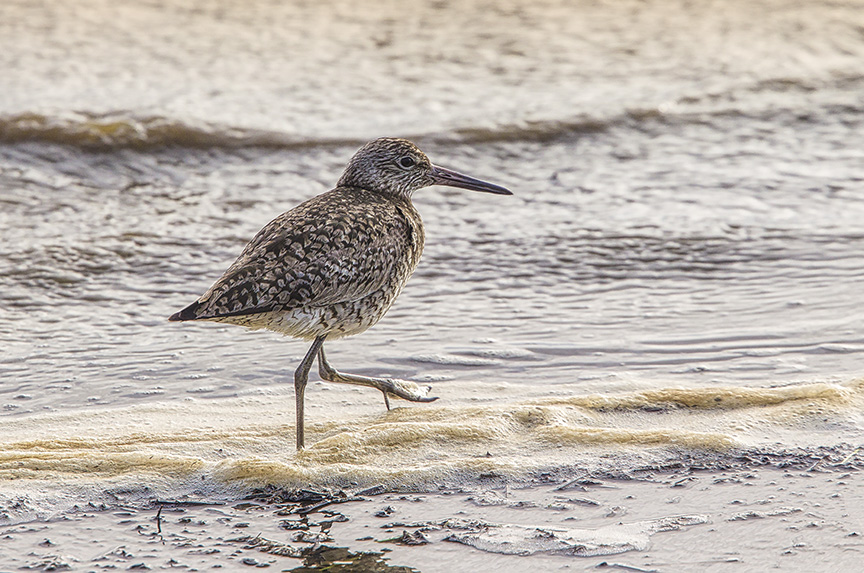
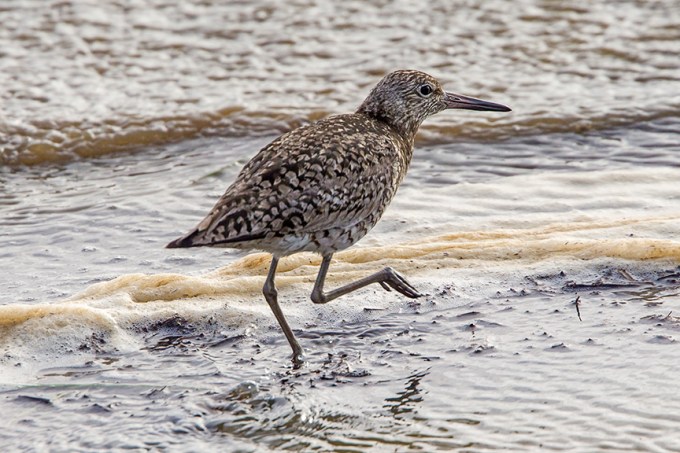
We saw this Sandpiper walking in the surf on the beach. There was an opening in the grasses along the Wildlife Drive so we had an opportunity to get a few shots before it walked past the opening. 
Egret Through The Grasses
Posted on June 15, 2017

I photographed this Snowy Egret as it walked by where I was photographing the Osprey nest. There was a batch of grasses in the way, so I waited until the Egret walked into an opening in the row of grasses to get a few shots before it moved along.
Curlews Across The Channel
Posted on June 13, 2017

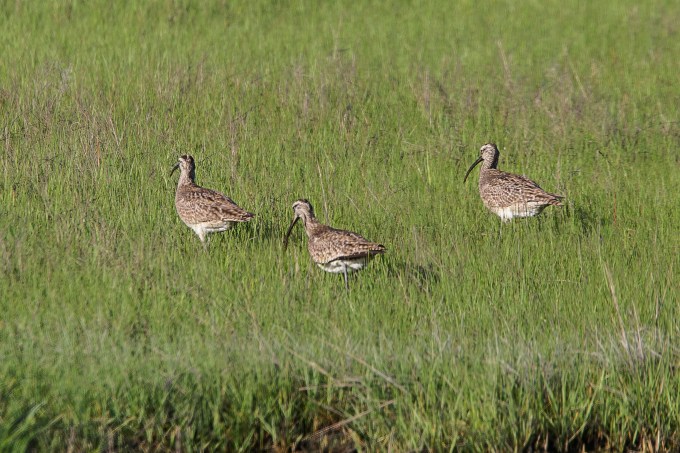
I saw this group of Curlews across the water channel along the Wildlife Drive. Usually I only see one working an area, but here I saw 3 working an area for a meal. The one on the left caught something, not sure what it was but usually when they peck at the ground or forage in grasses they are going after grasshoppers, beetles or other insects. If you see them going deeper with their long bills they are foraging for earthworms, shrimp, clams, etc. This group was just slowly walking and pecking at the ground. But it was fun to see a small group working an area out in the open.

Egret Portrait
Posted on June 2, 2017
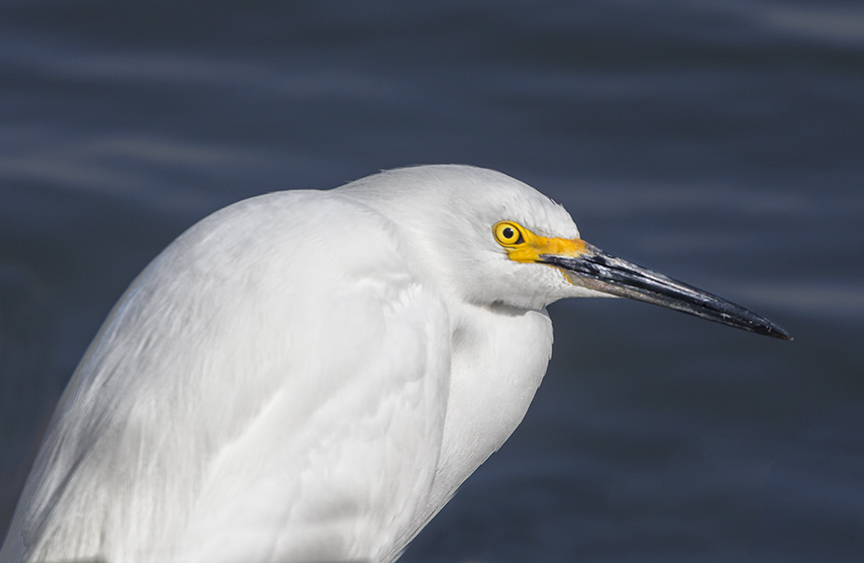
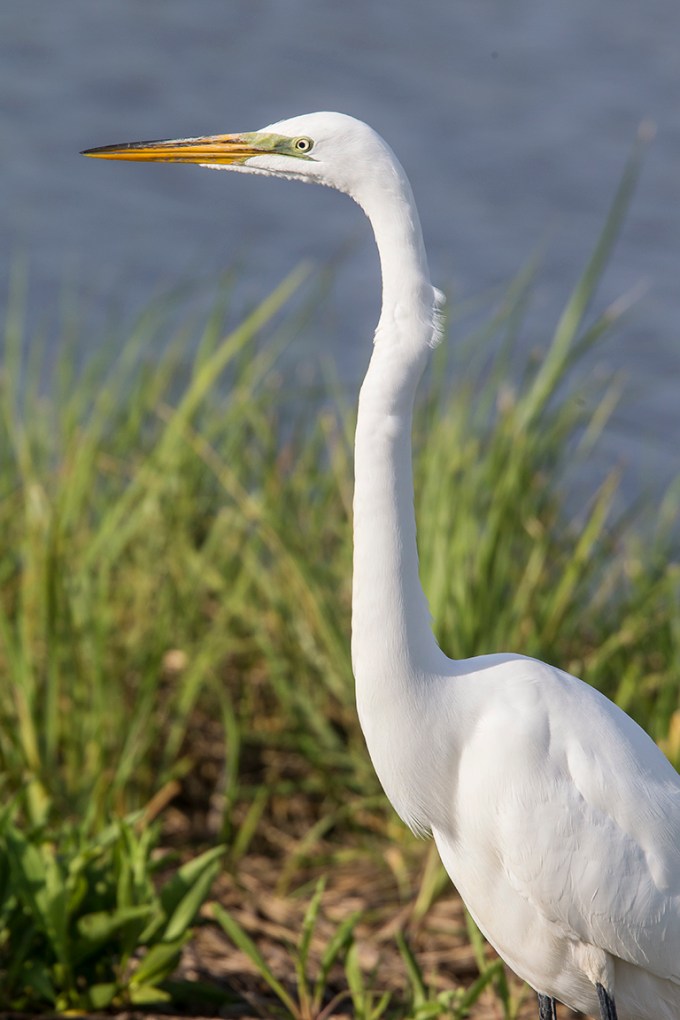
Usually when you are photographing birds you can not get close enough. In this image I was, sort of, too close. Plus the rest of the Egret was blocked by a concrete spillway. So I could not shoot a bird panorama to get the whole bird. So I settled on a Egret Portrait. Then moved on to the next Osprey nest.
Ospreys On Nest
Posted on June 1, 2017

I saw this pair of Ospreys was working on the nest, rearranging sticks in the nest. As I was photographing them I was surprised that they started to mate. Then the male flew off and landed in the grasses near the nest. It is interesting to see them working on the nest, rearranging sticks and bringing more sticks to the nest. On other nests being built, sometimes you see plastic bags, food wrappers all kinds of garbage they bring to build the nest. This one was very clean looking, but it was early in the building of the nest. These were taken at the Brigantine Division of the Edwin B. Forsythe National Wildlife Refuge in Oceanville NJ. This area is great for photographing the nests from the Wildlife Drive. The road is higher, then the sides along the road slopes down gradually to the water or channels, so you are looking almost directly across at the Osprey Platforms, instead of looking up. Most are somewhat close so if you are patient you can get quite a variety of photos of the Ospreys building the nest, flying to & from the nest, flying around the nest, etc. Sometimes they bring a fish and feed the young or just eat it themselves at the nest. Being patient helps, but you can always drive along the Wildlife Drive which is basically a loop, getting other interesting shots and come back to the nests to see if anything is happening. Also often you see them defending the nest from Gulls, hawks or other predators. At Blackwater NWR, in Maryland, you see Bald Eagles going after Ospreys to steal their catch. They also have a few Osprey platforms but are much farther out in the water
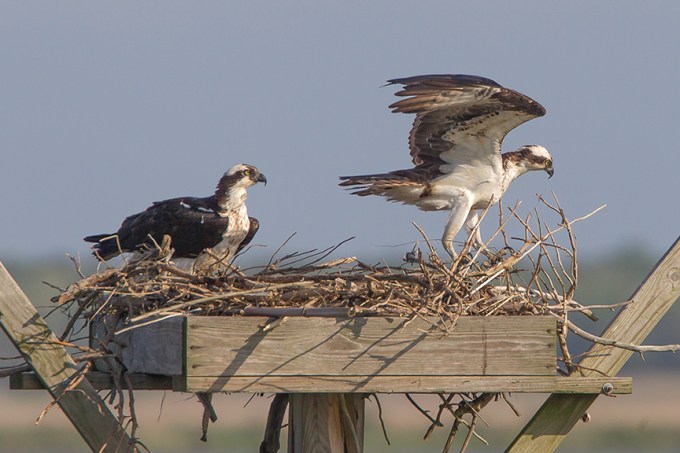
Female Osprey arranging sticks in the nest
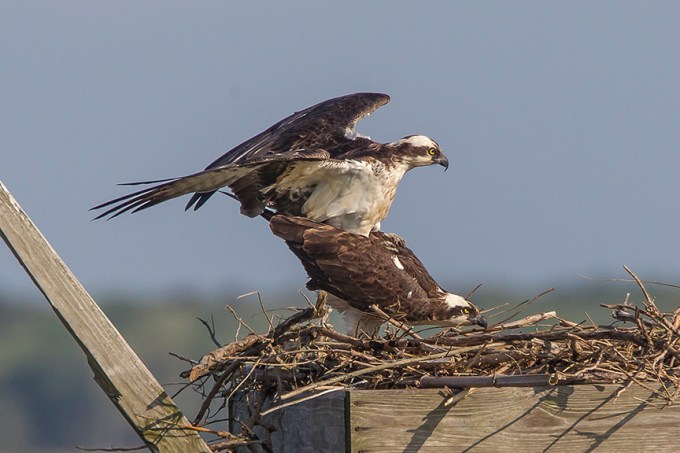
Ospreys mating

Male Osprey flying off, leaving the nest

Wider view of the nest
Unusual Osprey Nest
Posted on May 31, 2017

This is the 2nd year in a row I noticed an Osprey nest in this old, broken and battered remains of a small tree along the Wildlife Drive. It probably is only 4 feet off the ground, the lowest ever Osprey nest I have seen. They usually seek out a high position to protect the nest. They usually are high in trees, utility poles, towers, streetlights, almost any high structure that has enough space to put a nest. In Florida I remember seeing a street with almost every street light along the street occupied with Osprey nests.
I do not know if this is the returning Osprey from the previous year or just any easy place to put a nest.

Views of the nest

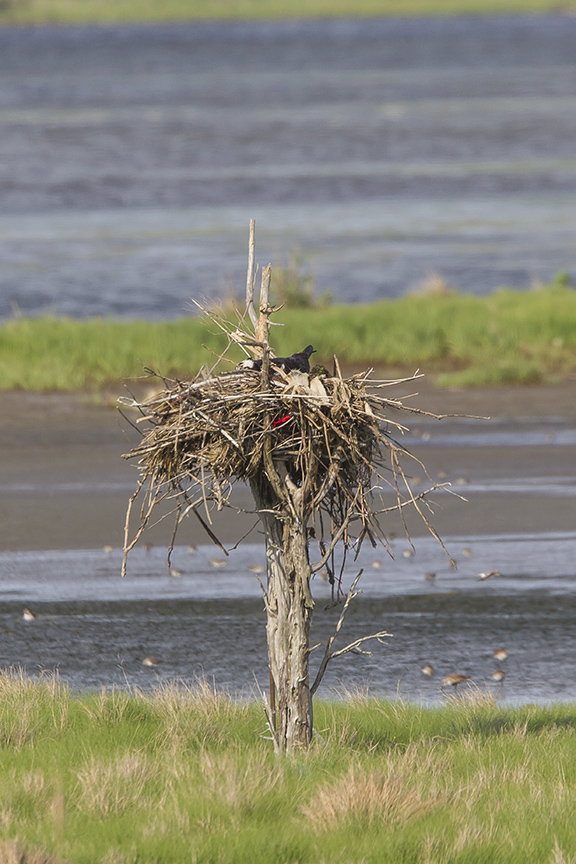

A Series of Horizontal Images to Compose a Vertical View Of The Surrounding Area
Great Egret – 5 Shot Egret Panorama
Posted on May 29, 2017
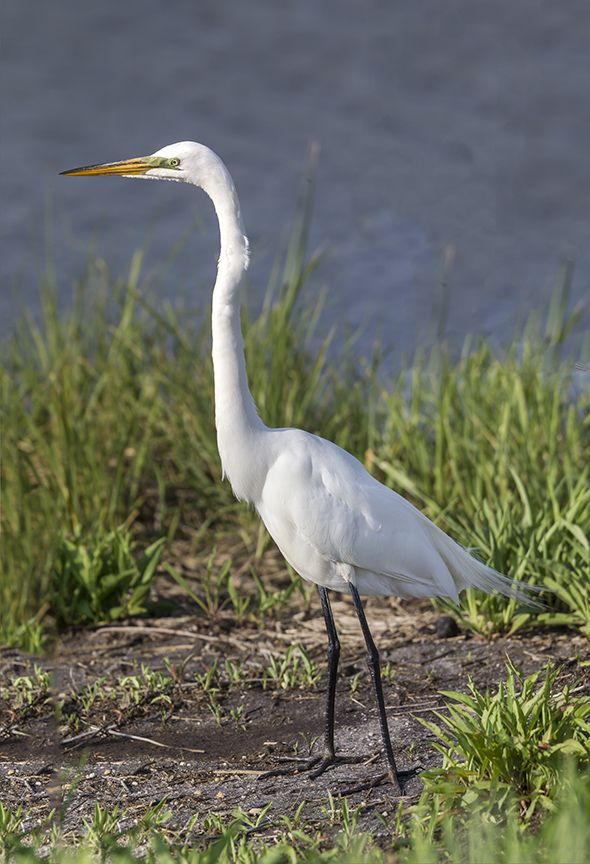
When I am photographing at an area in the car, I usually only use one main lens. At Brigantine I am usually using a 400mm f/4 D.O. Lens with a 1.4x teleconverter. Mainly because there is not time to switch because the subject could be gone and mostly subjects are far away. I have other equipment in the back of the van, usually with a wide angle zoom or a m43 camera with a 14mm – 140mm lens. But on the Wildlife Drive, when I come upon a subject, I do not have time to switch equipment before the subject is gone, so I make do with what I have in my hands. Many times I just shoot a multi-shot series and combine them in Photoshop. This mostly works well, plus I get a much larger file. Doing so many over the years, it seems 2nd nature now. Plus the newer CC PhotoShops work extremely well for assembling these multishot panoramas or stacked images.
Black Skimmers In Flight Panorama
Posted on May 28, 2017

When we were at the Edwin B. Forsythe National Wildlife Refuge a week ago, I tried some in-flight panoramas of the Black Skimmers. I was wondereing if it was possible to shoot a burst of images and pan at the same time. It works, but helps if you have some details in the background that PhotoShop can align the images to, instead of just Blue sky. It is a little harder if they are coming at you. It also helps, because of panning while shooting, to use a fairly high shutter speed. A panning gimbal head on a tripod would be good also, but I was handholding the camera for this series. The featured image was 5 shots, brought into Photoshop, automatically aligning the 5 shots and blending them. The more panos you try, the better they seem to come out. I could get large flocks of birds with a wide lens, but I like the challenge, plus I do not want a lot of extra background top and bottom. Also I tend to print images quite large. I will probably clone out the water tower and buildings later.
Another panorama from the same day, a different flock of Black Skimmers in the water. (With a few gulls in the background)

Black Skimmers and Gulls 6 Shot, overlapping images, panorama, @400mm
Black Skimmer Fishing
Posted on May 25, 2017

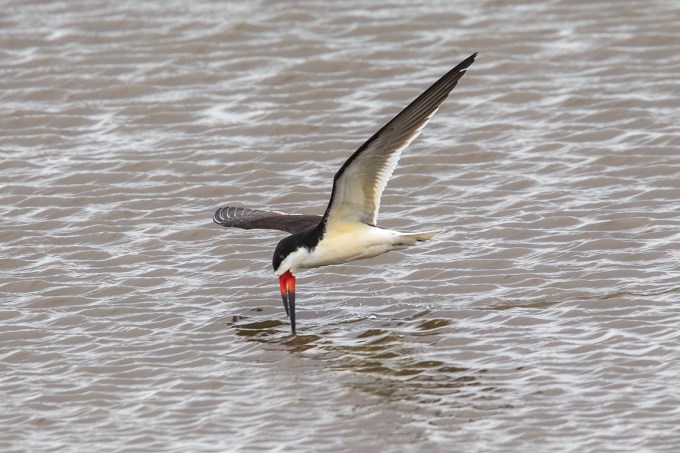
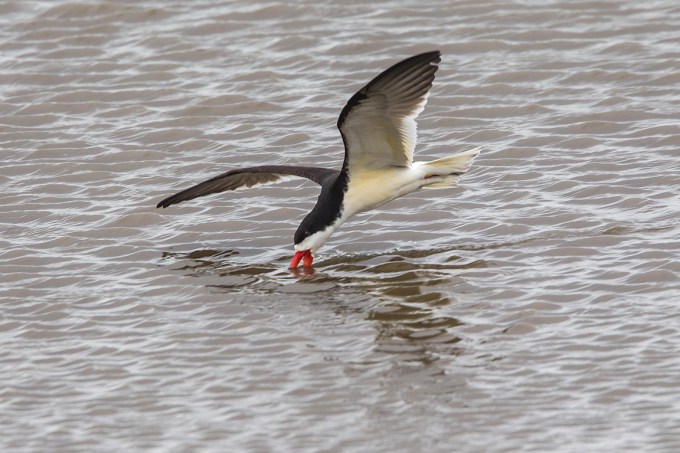
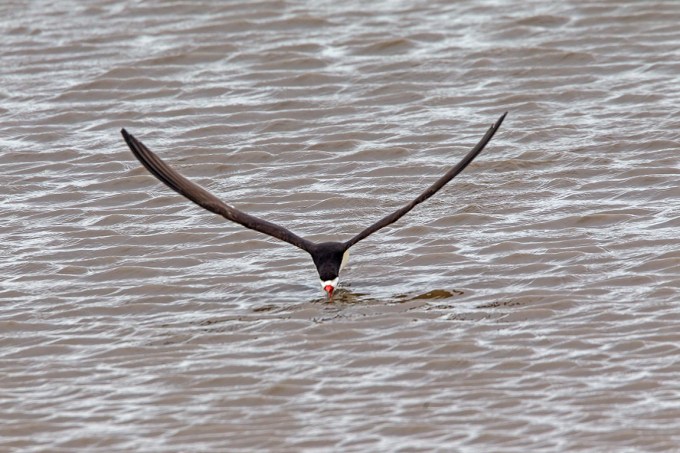
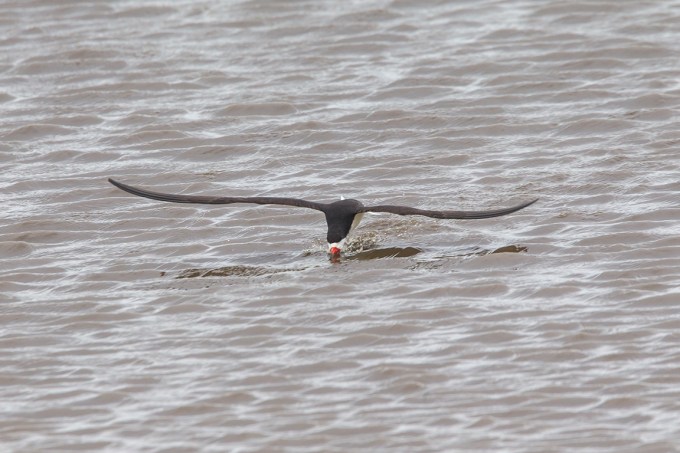
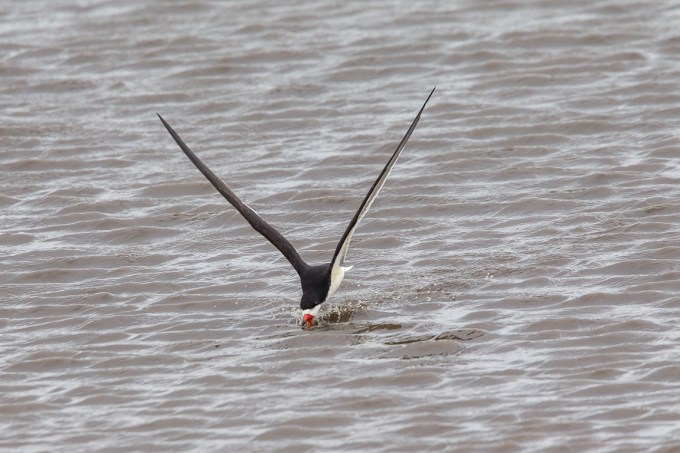
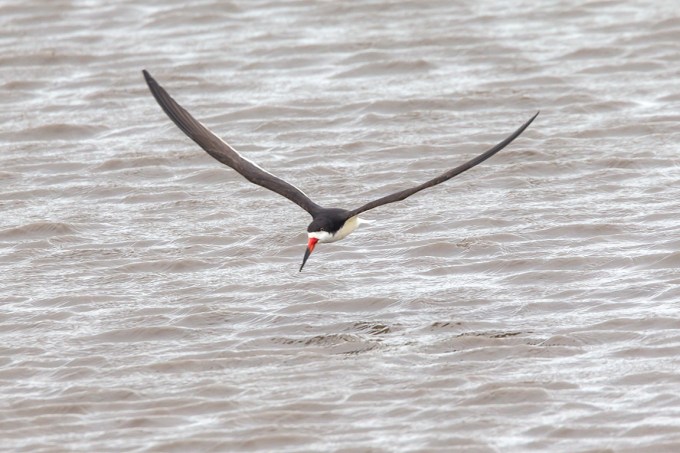
When we were at the Brigantine Division of the Edwin B. Forsythe National Wildlife Refuge in Oceanville, NJ last weekend, the weather did not cooperate with us. It was a very gray day and extremely windy. It was difficult to even open the car doors to get out. There were very few birds flying and those that did were just blown all over. There were Ospreys in all the nests along the Wildlife Drive, but only saw 1 flying very high in the air. There were large groups of Black Skimmers, mostly on the ground, but a few groups took off but were blown all over. I shot a few large groups of Skimmers on the ground also, for a few series of multi-image panoramas. On the way out of the Refuge, I noticed this one lone Black Skimmer fishing close to shore, skimming along. It was still very gray and overcast, but I got a series of shots of the Skimmer as it kept getting closer to us. They show the fishing technique of the Skimmer and how it got its name. When it thinks it has caught something the head bends down and it clamps down on the lower mandible to catch its meal. Many times it is just some debris in the water. It did not catch anything in that pass and it flew off, but it was fun to see.




Great Egret Gliding In
Posted on May 17, 2017

A Great Egret gliding by at a local Wildlife Preserve, early in the morning.
 photoartflight